Rising Three Methods: A Brief Pause in a Bullish Trend
The Rising Three Methods pattern is a clear bullish continuation signal in technical analysis, often appearing within an uptrend. Imagine it as a brief pause - three small downward candles nestled between two larger upward ones - before the climb resumes. When this pattern forms, it’s a steady hint that bullish momentum is taking a breather to recharge, offering traders an opportunity to buy or go long as the uptrend presses upward.
How to Identify the Rising Three Methods Pattern in Trading
The Rising Three Methods is a bullish continuation candlestick formation. It develops during an uptrend as buyers pause briefly before resuming control. The setup confirms when the final candle closes above prior resistance. Here’s how to spot it:
Start with the Big Picture
This pattern forms during an uptrend. Buyers dominate first, then step aside briefly while sellers attempt a small counter-move, before momentum returns to the upside.
Trace the Five-Candle Sequence
The structure unfolds in five distinct candles. Identifying each stage confirms the setup.
- First Candle: A long bullish candle driving the trend higher.
- Second, Third, and Fourth Candles: Three smaller bearish candles that drift modestly lower but stay within the first candle’s body.
- Fifth Candle: A strong bullish candle that closes above the first candle’s high.
Zero in on the Confirmation Level
The confirmation level is the high of the first candle. The fifth candle must break and close above this level to complete the pattern.
Watch the Breakout
The bullish trigger comes when the fifth candle closes above the first candle’s high.
- A decisive close above resistance or
- A large bullish candle
Both confirm continuation of the uptrend and provide the entry.
Check Volume for Additional Confirmation
Volume behavior reinforces the continuation.
- Spikes on the first candle as buyers dominate.
- Declines during the three middle candles while the market pauses.
- Surges on the fifth candle, confirming buyers have regained control.
Rise Up: Measure the height of the first candle and project it upward from the fifth candle’s close for a realistic price target.
How to Trade the Rising Three Methods Pattern (Trading Example)
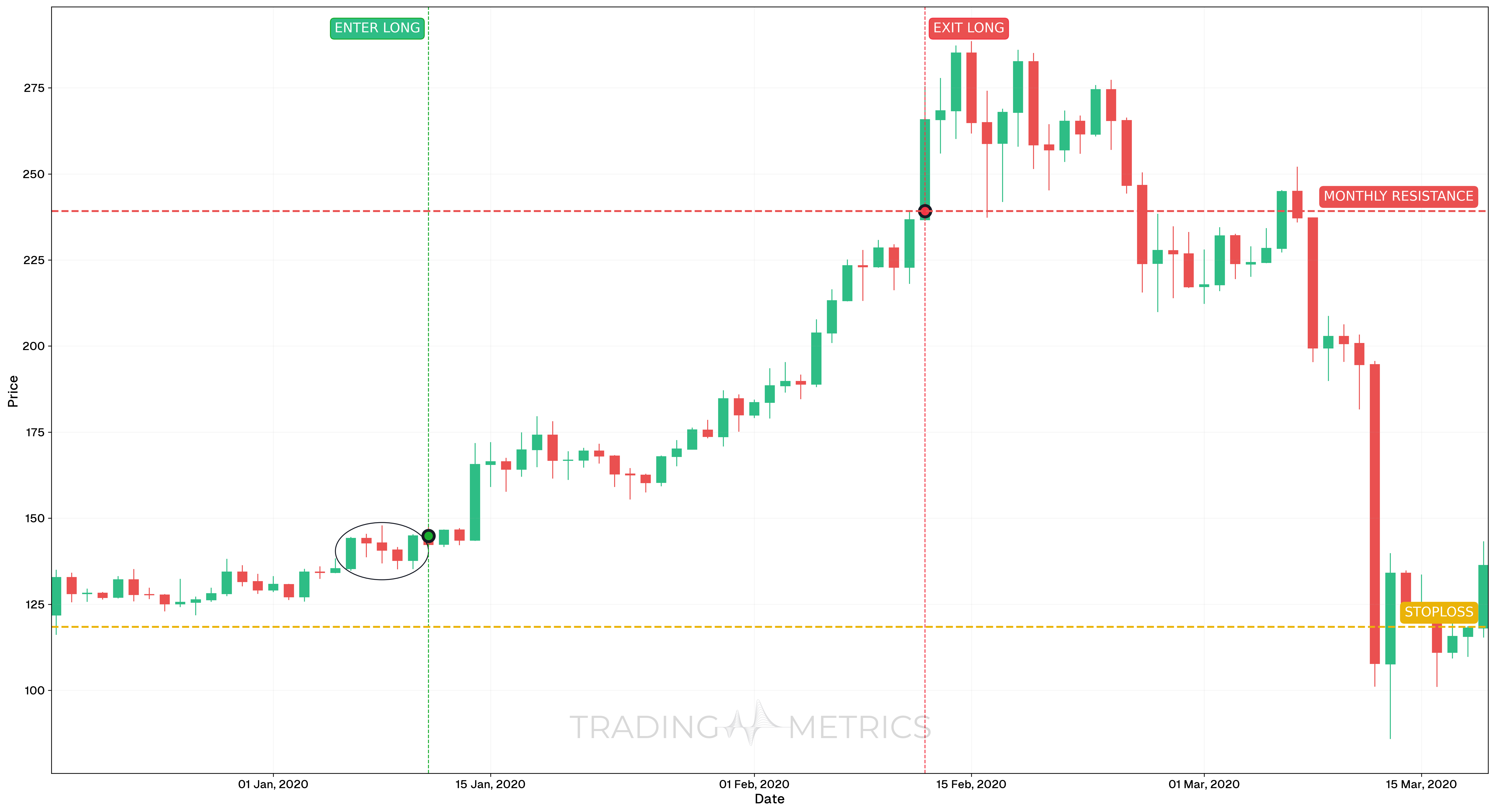
To illustrate how the Rising Three Methods pattern can be used to enter a trade, we will choose the ETHUSDT pair. This setup appeared on the daily chart, signaling a bullish continuation within a developing uptrend.
Analysis
Between mid-December 2019 and early January 2020, ETHUSDT formed a clear Rising Three Methods pattern. This consisted of a strong bullish candle, followed by three small-bodied candles moving slightly lower within the range, and a final strong bullish continuation candle. The pattern confirmed healthy consolidation within a larger uptrend.
Trade Setup
- Entry: The trade was entered on January 11, 2020, at $144.83, immediately after the pattern completed with a bullish breakout candle. Additional confirmation came from:
- RSI trending above 50 and rising, reflecting growing bullish momentum
- Exit: The position was closed on February 12, 2020, at $239.32, at a significant previous support/resistance level. This structure had capped prior rallies and offered a reliable place to secure profits.
- Outcome: The Rising Three Methods pattern yielded a 65.3% gain, following through with a strong bullish move after the continuation signal.
Risk Management
- Stop-Loss placement: The stop-loss was set at $118.45, below the low of the pattern and key prior support, ensuring protection if the continuation failed.
- Position sizing: The position was sized using a 2% capital risk model, based on the entry-to-stop distance.
- Risk-Reward Ratio: This setup offered a Risk-Reward Ratio of 1:3.58, providing excellent efficiency with tightly managed downside.
- Volatility Consideration: The pattern formed during a period of decreasing Volatility, followed by expansion on breakout. This structure signaled orderly accumulation and safe re-entry for momentum traders.
- Adaptive Exit Strategy: While the trade was exited at resistance, traders seeking longer exposure could have trailed with a short-term EMA or held for measured move projections.
Volume Boost: Rising volume on the final breakout candle confirms strength - don’t skip it.
Pre-Trade Checklist
Pattern Validation: Use tools like RSI, trendlines, or volume to validate structure and breakout strength.
Key Points
- Structure is King: The middle candles must remain within the first candle’s range - no exceptions.
- Breakout Clarity: Wait for a bullish close above the initial high - avoid guessing early.
- Trend Is Essential: This pattern only works within an uptrend - check higher timeframes.
- Volume Confirms: A volume spike on the final candle seals the signal.
- Precision Entry: Ideal for tight stops and high R:R setups.
- Timeframes: Works well on 4H, daily, or even weekly for swing trades.
Discipline Wins: Don’t force it in chop or downtrends - the pattern needs clean trend context to shine.
Conclusion
The Rising Three Methods is a crisp, bullish continuation candlestick pattern - best played with patience and confirmation. Its strength lies in structure, range control, and the breakout candle’s conviction. Combine it with volume, trend analysis, and tools like RSI to raise your edge. When spotted in the right place, it’s a powerful signal to stay in the trend and let the bulls take you higher.
Frequently Asked Questions
Quick answers based on this page's topic.
It signals that an uptrend is healthy and simply taking a breather. The three small middle candles show that sellers are weak and cannot drive the price below the first candle's origin. The final fifth candle confirms that the bulls have absorbed all available supply.
The fifth candle provides the necessary breakout confirmation. By closing above the high of the first long bullish candle, it proves that the period of hesitation is over and that the market has enough demand to continue making new highs.
While it can appear on lower timeframes, it is most reliable on the 4-hour and Daily charts. Higher timeframes filter out market noise, ensuring that the three-candle consolidation represents a genuine pause in institutional flow rather than random price fluctuations.