Advance Block Pattern: When a Rally Runs Out of Buyers
The Advance Block pattern is a bearish reversal signal consisting of three consecutive bullish candles within an uptrend, but each candle shows signs of progressive weakness. Unlike a clean reversal, this pattern warns of a gradual loss in bullish momentum, hinting that buyers are losing control. It serves as a subtle yet powerful heads-up that a trend reversal may be near, especially when supported by volume and momentum divergences.
How to Identify the Advance Block Pattern in Trading
The Advance Block is a bearish exhaustion candlestick formation. It develops over three bullish candles during an uptrend, with each showing progressively weaker momentum. The setup serves as an early warning that buyers are losing control. Here’s how to spot it:
Start with the Big Picture
This pattern forms during an uptrend. Buyers push higher across three candles, but the strength behind each advance fades, signaling exhaustion at the top.
Trace the Three-Candle Sequence
The Advance Block is made of three bullish candles. Recognizing how each weakens confirms the setup.
- First Candle: A strong bullish candle extending the uptrend.
- Second Candle: Another bullish candle that closes higher but with a smaller body and often a long upper wick.
- Third Candle: A bullish candle with an even smaller body, larger upper shadow, or a close near the open.
Zero in on Diminishing Strength
The shrinking bodies and growing upper shadows show rising resistance and seller pressure creeping in, despite bullish closes.
Watch the Momentum Shift
Although all three candles are bullish, the lack of real progress and signs of exhaustion act as your bearish clue. This is not a direct entry trigger but a warning of potential reversal.
Check Volume for Additional Confirmation
Volume behavior helps validate the signal.
- Declines through the sequence as buying power weakens.
- Or shows distribution spikes as sellers quietly step in.
- Tools like RSI can add confirmation of fading momentum.
Fade Alert: Think of the Advance Block as a “slow fade” - use trendlines or nearby resistance zones to plan short entries with tighter risk.
How to Trade the Advance Block Pattern (Trading Example)
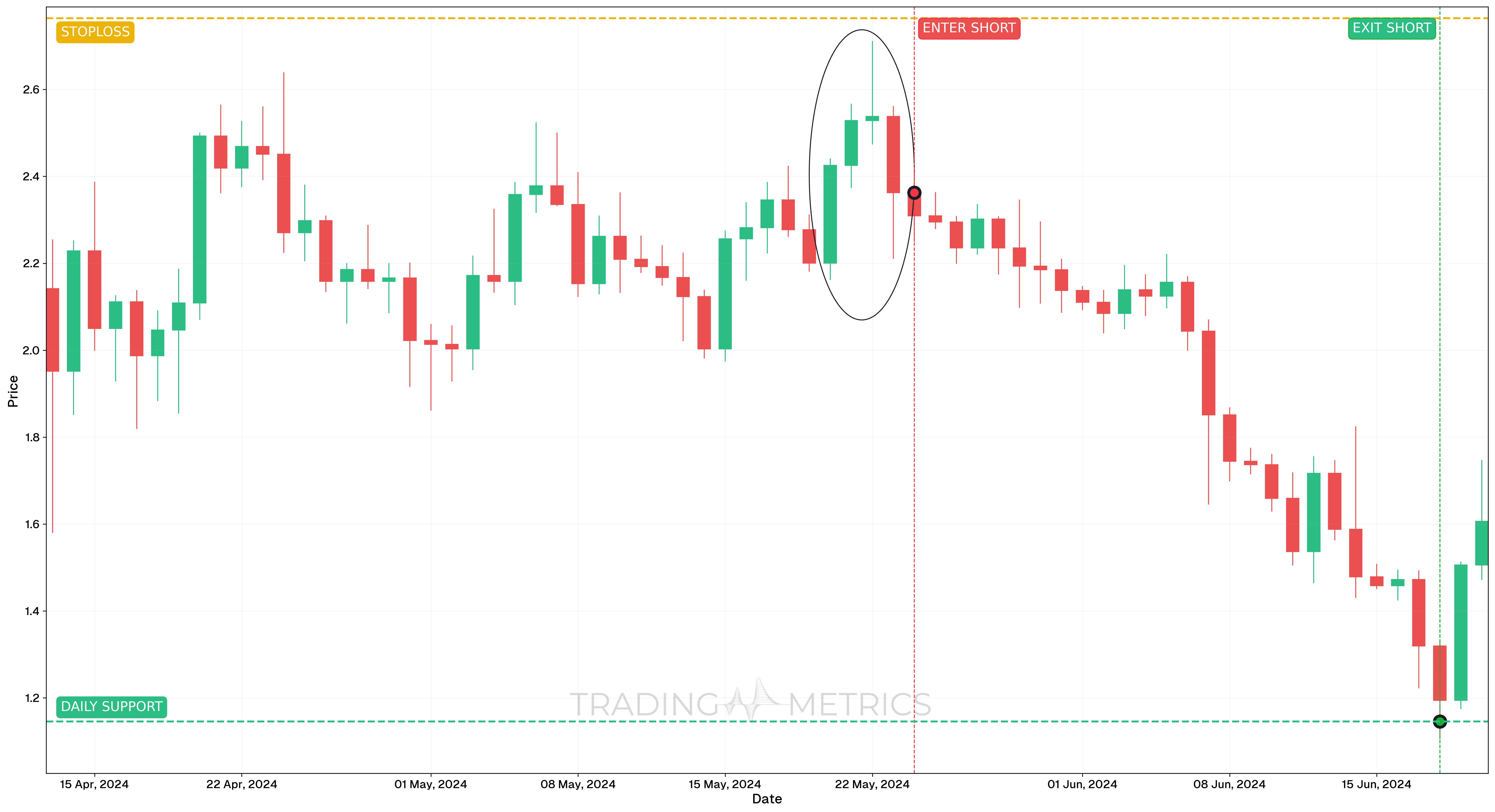
Let’s examine the BTCUSDT Perp pair, where an Advance Block formation appeared on the 4H chart after a prolonged climb. The pattern forecasted a slowdown, confirmed by loss of momentum and follow-through selling.
Analysis
On May 19, 2024, FETUSDT printed three consecutive bullish candles. The first had a large body; the second showed a long upper wick and smaller body; the third was nearly flat with upper shadow - classic Advance Block traits. RSI divergence aligned with a Rising Wedge breakdown.
Trade Setup
-
Entry: A short was entered just after the third candle closed on May 24, 2024, at $2.3625, as momentum confirmed weakness.
- RSI showed bearish divergence
- Price was rejecting a Fib extension + resistance
-
Exit: Closed on June 18, 2024, at $1.1458, near prior VWAP support and trendline confluence.
-
Outcome: The trade yielded a 51.49% decline, capturing a weakening top without chasing the breakout.
Risk Management
- Stop-Loss placement: The stop-loss was set at $2.76384, just above the third candle’s high and local structure top.
- Position sizing: Based on a 2% capital risk, calculated using the range between entry and stop.
- Risk-Reward Ratio: This setup achieved a 1:3.03 Risk-Reward Ratio.
- Volatility Consideration: The setup followed a volatility compression, then broke support with rising volume.
- Adaptive Exit Strategy: Price scaled down toward demand zones, with optional trail stop below lower highs.
Don’t Rush: Let the Advance Block mature - enter after signs of exhaustion, not mid-pattern.
Pre-Trade Checklist
Watch the Fade: Look for weakening candles and use tools like RSI and volume divergence to confirm.
Key Points
- Gradual Reversal: The pattern warns of exhaustion over three candles, not a sharp turn.
- Upper Shadows: Increasing wicks signal seller pressure rising.
- Candle Shrinkage: Smaller bodies show declining strength - key trait.
- Context Is Crucial: Most effective after sustained uptrends near resistance.
- Volume Decline: Falling volume adds weight to the stall.
- Confirmation Helps: Use trendlines, EMA, or divergences to trigger entry.
Let It Unfold: Don’t front-run the Advance Block - wait for weakness to confirm.
Conclusion
The Advance Block pattern is a subtle but effective early signal that buyers are tiring. Unlike immediate reversal pattern, it offers a staged warning before a potential trend shift. Pair it with volume cues, momentum divergence, and resistance zones to improve trade timing. Patience and confirmation make the Advance Block a powerful reversal companion.
Frequently Asked Questions
Quick answers based on this page's topic.
The Advance Block is an exhaustion pattern consisting of three bullish candles with progressively smaller bodies and longer upper wicks. It signals 'bullish attrition,' where buyers are still pushing for new highs but are meeting increasing resistance, suggesting the trend is nearing a top.
While both feature three bullish candles, Three White Soldiers have large, strong bodies that close near their highs. In contrast, an Advance Block shows 'weakening' candles with long shadows, indicating that bulls are losing their grip and a reversal or deep pullback is imminent.
No. The Advance Block is primarily a warning sign to tighten stop-losses or take profits on long positions. Because it represents a gradual loss of momentum rather than a sharp rejection, professional traders wait for a clear bearish break of market structure before entering a short.