Volatility Awareness: Strategic Risk Adjustment in Fast Markets
Volatility Awareness is not just about understanding how volatility behaves - it’s about how you respond to it as a trader. It’s the strategic edge of recognizing changing market dynamics and adapting position sizing, stop placement, entry timing, and even emotional control in response to market volatility.
Unlike standard measures like Average True Range (ATR) or Bollinger Bands, which quantify volatility, Volatility Awareness is a mental framework and a tactical approach to applying that information in real-time.
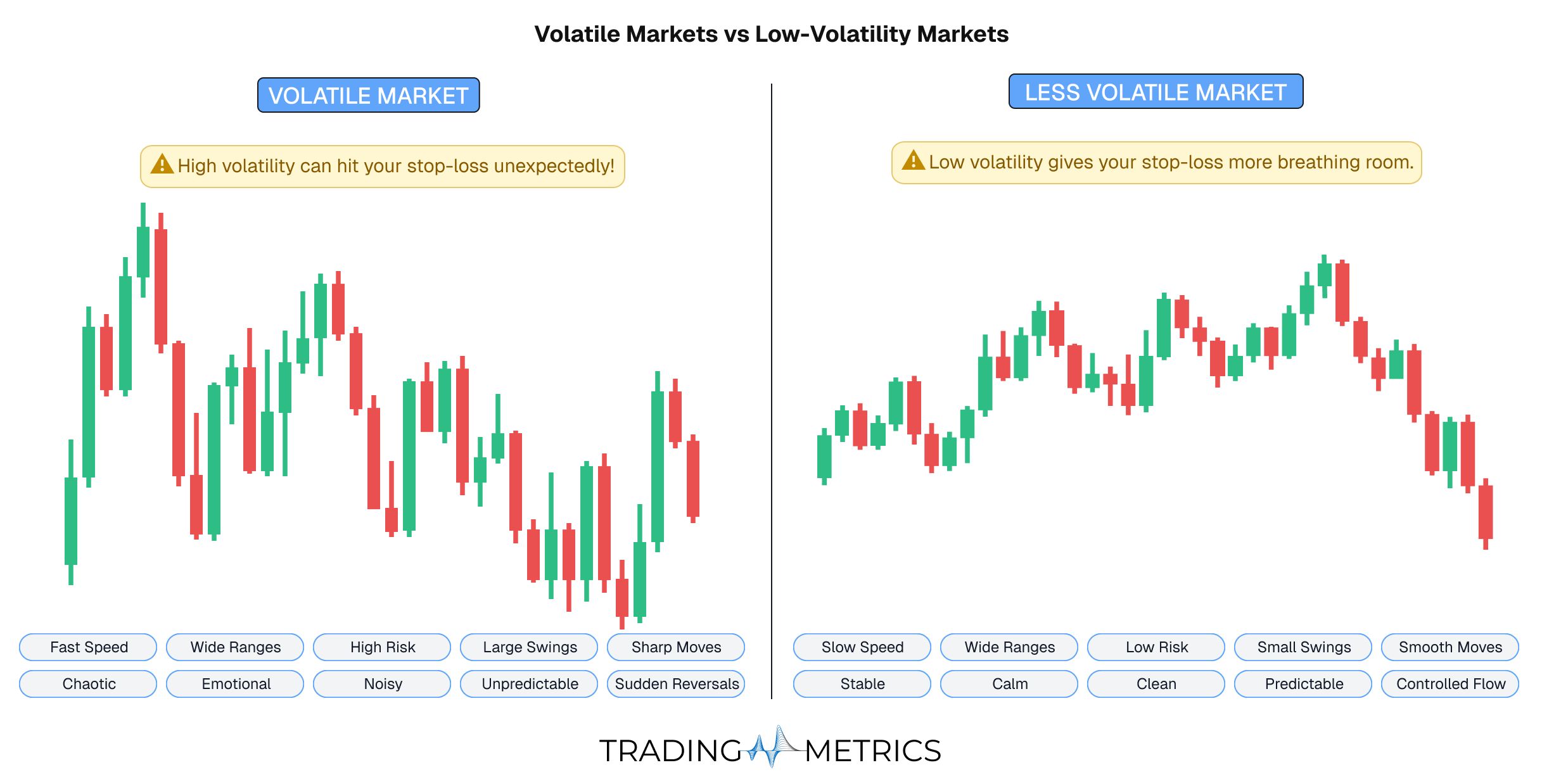
What is Volatility Awareness?
Volatility Awareness is a trader’s ability to recognize the current volatility environment and adjust their behavior and strategy accordingly. This includes:
- Knowing whether the market is in a high or low volatility regime
- Understanding how different assets typically behave during varying volatility phases
- Adjusting trade expectations, risk, and strategies based on volatility
It’s about situational awareness of the trading environment – similar to how a pilot adjusts for turbulence.
Identifying Volatility Regimes
Before you can adapt to volatility, you need to measure it. Here are practical ways to identify the current regime:
Using ATR (Average True Range)
ATR is the most practical volatility indicator for day-to-day trading:
- Low volatility = ATR is below its 20-period moving average
- Normal volatility = ATR is near its 20-period moving average
- High volatility = ATR is above its 20-period moving average
Example:
- BTC typically has ATR of $800 on the daily chart
- Current ATR = $1,200 → High volatility regime
- Current ATR = $500 → Low volatility regime
Using Bollinger Bands
Bollinger Bands visually show volatility expansion and contraction:
- Bands squeezing (narrow) = Low volatility, potential breakout coming
- Bands widening = High volatility, trending or breaking out
- Bands stable = Normal volatility
Quick Visual Check
Simply compare current price movement to recent history:
- Are daily ranges 2-3x larger than last week? → High volatility
- Are candles getting smaller and tighter? → Low volatility, compression
You don’t need complex calculations. The key is noticing when the market’s character changes - that awareness alone puts you ahead of most traders.
Why Volatility Awareness Matters?
Volatility Awareness is vital because:
- High volatility increases risk and Slippage - great for breakout traders, dangerous for range traders.
- Low volatility leads to choppy markets - better for mean reversion strategies but harder for trend followers.
- It improves position sizing. A trader might reduce size in high volatility to maintain consistent dollar risk.
- It sharpens your emotional regulation. Traders aware of increased volatility can brace for swings rather than panic-react.
Practical Adaptation Framework
Here’s exactly what to do in different volatility regimes:
High Volatility Regime (ATR > 1.5x Normal)
Position Sizing Adjustments:
- Reduce position size by 30-50% to maintain consistent dollar risk
- Example: If you normally risk 1% ($500), but volatility doubled, reduce size so risk stays at $500 despite larger stop-loss distance
Stop-Loss Adjustments:
- Widen stops to avoid getting shaken out by normal noise
- Use 1.5-2x ATR for stop distance instead of normal 1x ATR
- Expect more slippage on exits
Strategy Adjustments:
- Favor trend-following and breakout strategies
- Avoid tight range trades - they’re likely to get blown through
- Increase profit targets - volatility allows bigger moves
- Reduce trade frequency - quality over quantity
Psychological Adjustments:
- Expect larger account swings - don’t panic at normal volatility
- Monitor emotional state more frequently (use 1-10 scale from Trading Psychology)
- Take breaks if volatility is causing stress
High volatility is when most traders blow up by keeping the same position size and getting stopped out by noise or experiencing massive slippage. Adapt or suffer.
Low Volatility Regime (ATR < 0.75x Normal)
Position Sizing Adjustments:
- Can increase position size slightly (10-25%) since ranges are tighter
- But be cautious - low volatility often precedes explosive moves
Stop-Loss Adjustments:
- Tighten stops to match the compressed range
- Use 0.5-1x ATR for stop distance
- Expect less slippage
Strategy Adjustments:
- Favor mean reversion and range-bound strategies
- Avoid large trend bets - markets are choppy and directionless
- Reduce profit targets - expect smaller moves
- Watch for compression breakouts - volatility won’t stay low forever
Psychological Adjustments:
- Be patient - low volatility = fewer quality setups
- Don’t force trades out of boredom (common mistake)
- Prepare mentally for volatility expansion - it always comes
Normal Volatility Regime
- Trade your standard plan without major adjustments
- Monitor for regime shifts into high or low volatility
- Maintain baseline risk parameters
Volatility Regime Quick Reference
| Volatility Level | Position Size | Stop Distance | Best Strategies | Psychological Focus |
|---|---|---|---|---|
High (ATR > 1.5x) | Reduce 30-50% | 1.5-2x ATR | Trend-following, breakouts | Expect swings, stay calm |
Normal (ATR 0.75-1.5x) | Standard | 1x ATR | All strategies work | Execute plan normally |
Low (ATR < 0.75x) | Can increase 10-25% | 0.5-1x ATR | Mean reversion, ranges | Be patient, don't force |
The Golden Rule: When volatility changes, your position size must change inversely. Higher volatility = smaller size. Lower volatility = can use slightly larger size. This keeps dollar risk consistent.
Tools to Combine With Volatility Awareness
To sharpen your Volatility Awareness, combine it with:
- Risk-Reward Ratio to assess whether the trade is worth taking in the current environment
- Average True Range (ATR) stops for dynamic risk control
- Bollinger Bands to see range compression/expansion
- Volume to confirm whether a volatility spike is meaningful
- Market structure to avoid trading into chaos during volatility spikes
Key Points
- Volatility Awareness is a skill, not a number. It’s about recognizing the current Volatility environment and adjusting strategy accordingly.
- You build it by watching volatility tools like Average True Range (ATR), Bollinger Bands, or implied/realized volatility data.
- It affects everything from position sizing to trade selection and emotional management.
- It’s especially useful in fast-moving markets like crypto, where conditions change quickly.
- Pair it with tools like Risk-Reward Ratio, volume, and market structure to improve decision-making.
Volatility Awareness is the difference between reacting and anticipating. It’s not a tool - it’s a mindset rooted in observation, context, and discipline.
Conclusion
In the crypto markets - where volatility is a feature, not a bug - developing Volatility Awareness is one of the most underrated trader skills. It won’t give you trade entries, but it will make every decision more grounded in reality. From entries to exits to position sizing, this awareness helps traders stay in sync with the market rather than getting blindsided by it.
Frequently Asked Questions
Quick answers based on this page's topic.
Market regimes shift between high and low volatility. High-volatility environments favor trend-following and breakouts with wider stops, while low-volatility 'choppy' environments are better suited for mean reversion and tighter profit targets to avoid being trapped in ranges.
Indicators like Bollinger Bands and ATR are essential for tracking volatility. A 'squeeze' in the bands often signals a period of low volatility that is about to explode, alerting traders to prepare for a regime shift and adjust their risk accordingly.
The Sleep Test is a psychological gauge: if current market swings cause you to check your phone at night or feel constant anxiety, your risk is too high. Reducing your position size until you feel calm ensures you stay objective during wild price moves.